This article was written for the Brethren in Christ History & Life Journal in 2022
New Clothes:
Exploring the Brethren in Christ Core Values
Visual Art Project Brings the Community Together
by Geoffrey A. Isley
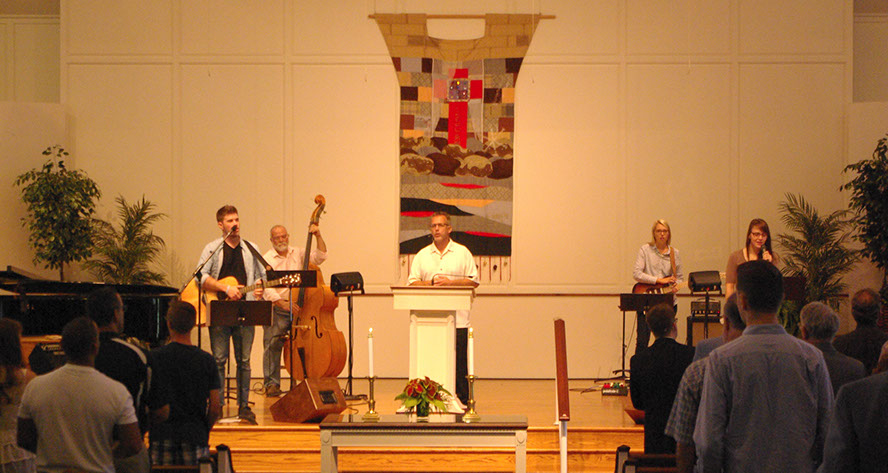
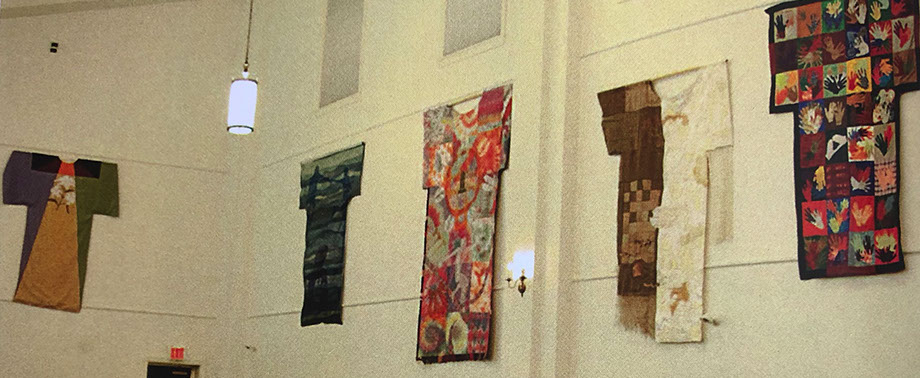
This community art project at the Grantham Church (Grantham, PA) came about because of some brainstorming among the worship planning group in August, 2007. We knew that senior pastor Terry Brensinger was preaching a series on the core values of the Brethren in Christ, starting in September, and going to January 2008, with a short break for the Advent Sundays. We were asked to develop a visual that would help convey the core values. in 2022
We started with Terry's sermon theme "New Clothes" and we talked about ways to help people relate to the need to purposefully "wear" these values in their lives, not just talk about them in church. These values get right down into the very fabric of our daily lives. We talked about how we might use various common clothing fabrics in creative ways. Eventually, we arrived at the idea to create ten "robes" that would be sewn or created from the fabrics donated by the congregation and put together by as many people who wanted to participate. We felt the community involvement itself — regardless of the appearance of the resulting robe — would demonstrate the value, and the congregation would feel more ownership both of the finished artwork, but of the core values themselves.
Before the first Sunday of the series, Dale Wolgemuth helped me cut a sheet of plywood into the shape of a eight-foot-wide clothes hanger which I painted gold. This was hung alone at the front of the sanctuary, so that the first thing you saw was this giant golden hanger. A short, funny skit by Liz Bar and Ron Ross drew even more attention to it at the beginning of the service, so that everyone was aware that we were starting a new series of sermons. I had prepared some rough sketches to show people at a table in the narthex after the service, so we were able to promote the project and ask for volunteers and donations. All the interested people were invited to a quick meeting the following Sunday to see more specifically what needed to be done, and within an hour the first four robes had been claimed by a group of eager, creative people.
These separate groups started working on their robes. Fabric donations started showing up each Sunday in a huge laundry hamper placed strategically in the foyer. These robes needed to be designed and created and ready to hang in just a few short weeks. Each subsequent Sunday, the hanger displayed the newest robe — which the sermon would bring to life. The robes then moved to the side walls of the sanctuary, so that by the end of the series we had ten new robes in the worship space — like a beautiful community closet of new clothes.
1. Experiencing God’s Love & Grace
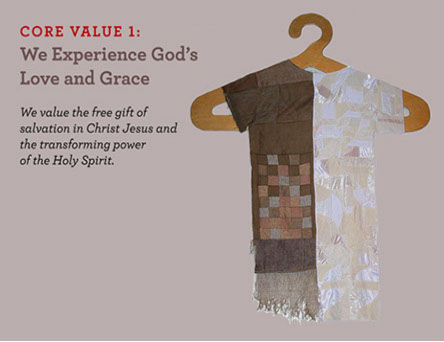
Photo caption: This robe is made of burlap on the left side, and fine satins, silks, and fine bridal gown fabrics on the right. Erika Anderson did the “refined” side and Geoffrey Isley did the “rough” side.
Because this banner was the first one, and it was being used both as an introduction to the sermon series and the first core value itself, it needed to be completed in just two weeks from the initial approval of the designs. Luckily it was scheduled to hang for three weeks in all, so there was a little more time to work on robe number two. I asked my neighbor, Erika Anderson, who I knew was an accomplished seamstress to help with the “pretty” side of the robe. She immediately agreed and went to town with some rich bridal-gown fabrics she found. Silks, satins and embroidered cloth in various shades of white form the background, with smaller overlayed elements that hint at some key biblical stories. The rough, brown half is mostly burlaps and rough homespun linen and cotton with deeper textures to contrast it the softer finer side. We wanted to heighten the contrast between the “before” side of the clothing with the transformation to the beauty on the other side, only made possible through Christ.
The artist’s statement that week said: “In viewing this artwork, look for reminders of the ways we experience God. Our lives are transformed by God’s working in and through us, by His Holy Spirit’s empowerment. We experience Him personally, but also through the lens of the Biblical story. God began a relationship with humanity when He chose to save Noah’s family in a wooden floating box. God chose to get Moses’ attention through a burning bush, and thus inaugurated His grand plan of salvation for His people — salvation we claim through Christ’s sacrifice. God rescued his fleeing prophet Jonah from death by sending a huge fish to swallow him for three days. God’s love is pro-active, and purposeful. He is present in times of trial and persecution, and we have confidence in His promises to save us. He is our example of love and grace.”

2. We Believe in the Bible
Photo caption: This robe was created by Sylvia Emberger and Geoff Isley.
I had given some initial designs to Sylvia Emberger to get her started on this one, and she really had fun incorporating these earth and stone fabrics into the design, while adding many more beautiful elements such as the high-priestly breastplate with the ephod, and the bells and pomogranates as a fringe at the bottom. The imagery of digging down through the layers of rock alludes to the discovery of historical truth in the Bible. The archeological layers of earth moving from deep and sedimentary at the bottom, to old-style and then increasingly modern brick-work near the top reminds me of the passage of time. There are quilted elements of Hebrew, Greek, Latin and English texts. The central cross and ripped temple veil all symbolize important concepts for this core value.
The artist’s statement that week said: “In viewing this artwork, look for reminders of God’s revelation through the Holy Scriptures. The Bible is foundational to our faith — like bedrock — it is where we read about God’s work among his people. God chose a particular tribe in a particular part of the ancient world to speak with personally and he began an intimate relationship. He introduces himself with his personal name! The scriptures have come to us in our time through a great deal of careful preservation and translation. We understand and study the Bible through historical and cultural lenses. It is through these written language that we learn of Christ's becoming our perfect sacrifice, our High Priest, the one who saves us.”
3. We Worship God
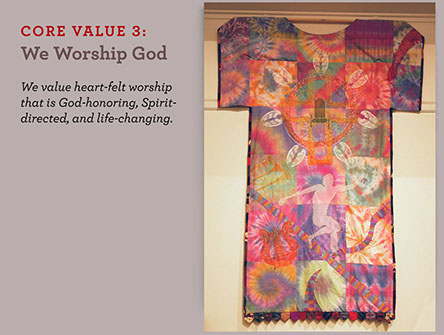
Photo caption: This robe was designed and created by Geoff Isley. With the guidance of Renee Durbin, the Youth Group tie-dyed the main fabric panels for this robe. The silk neckties along the borders were donated from the men of the congregation.
This banner is the largest one, and came together through the efforts and contributions of many diverse groups in the congregation. The main body of the robe is constucted of large squares of brightly tie-dyed cotton. This was an activity of the entire youth group one Sunday evening. Many donated men’s neckties were deconstructed and became a border and bottom edge of the robe, and then I “drew” with glitter glues the other deisgn elements. I feel this banner is much “louder” than most of the others — I almost hear the music of our corporate worship, which was very intentionally intergenerational. It was essential to my design that this core value emphasize the “we” in the title, the vast expanse of expressions of “worship,” and clearly focus on the One whom we worship. The cross and throne in the center are surrounded by seven angelic worshippers along with text in English, German, and Spanish.
The artist’s statement that week said: “When reading the chapter on this core value I was struck with our connection to the worship happening throughout all of history around the throne of God in heaven. The cherubim and seraphim singing “Holy, Holy, Holy ...” Seeing God on His throne, and praising Him is central to our worship. The brilliant, dynamic colors evoke the energy, movement, and rhythm of our worship, and there’s also a deliberate mix of ancient tradition and modernity. Music is certainly part of our worship, and in this congregation we are also exploring the elements of dance and visual art. We want our worship to reflect the passion we have for God, as we treasure the beauty of His holiness.”
4. We Follow Jesus
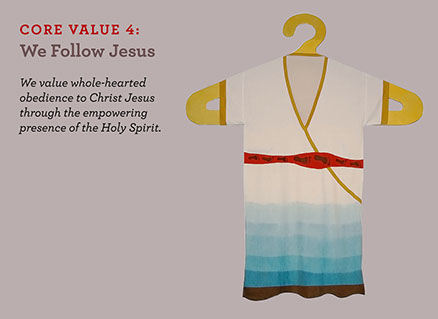
Photo caption: This robe was designed by Geoff Isley, and was created by Donna Bert and Sara Donovall.
This robe was all about baptism from the very start. I was struck by the fact that in many ancient cultures, being totally immersed in water was a very scary experience. People didn’t go swimming like we do today, and I imagined the swift current of the muddy Jordan perhaps being a place new believers would very fearfully enter. Being washed head-to-foot in a river would also be a rare experience for the first Christians. Surrendering one’s self to the water would certainly be a memorable experience, and a decision not lightly made.
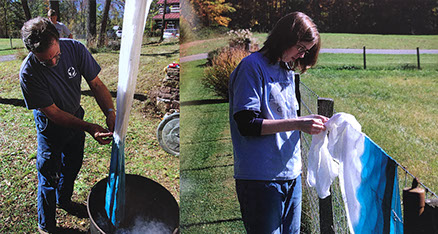
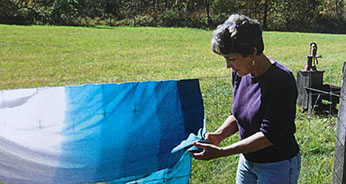
Also, the BIC don’t generally baptize infants. We stress believer’s baptism, so we don’t have the tradition of the baby’s baptism gowns, or christening dresses some other church traditions have. So when Donna Bert agreed to work with me on this robe, we talked about a fine white linen garment. We also talked about dying the bottom half to give the appearance of being dipped into the blue water, and changed forever. Her expertise as a weaver, dyer and fiber artist were invaluable as we talked through the process of getting from the design sketch to the finished robe. We even made the dying of the fabric a community event by invited people to come help with the dying process, and shared a meal together afterwards.
The artist’s statement that week said: “Our starting point in following Jesus is relinquishing our illusion of control, and embracing a life of obedience. This robe has been baptized, and the robe will never be the same. Baptism is our shared experience — a public declaration of the change Christ has made in our lives. We walk no longer on the safe, dry paths. We join the community of the baptized and walk obediently into sometimes dangerous, treacherous, swirling currents of a broken world. Christ calls us, and we choose to obey, to be His hands and feet, and to go and redeem this world. The bottom edge shows the effects of walking in obedience — even in the messiness of life. The red sash reminds us of Christ's sacrifice and the life of suffering we see on the path of obedience.”
5. We Belong to a Community of Faith
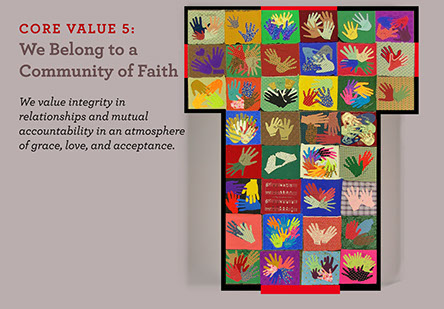
Photo caption: This robe was created by the whole community, and sewn together by Caroline Sider. Beth Huffnagle and Patti Hess provided leadership for insuring the whole community could partcipate.
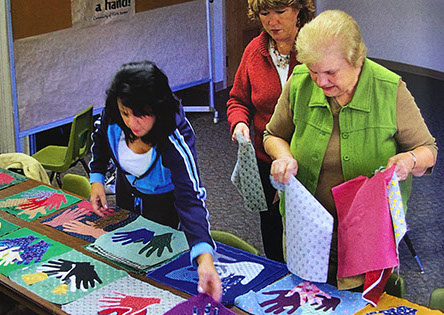
The robe that spoke to our valuing community itself came together with a intentional quilt format. The quilt seemed a natural way to use fabric, plus its connection to the long tradition of quilt-making as a gift from one generation to the next. It is also frequently a community activity, with quilters gathering around the frame to share their lives, tell stories, and work on completing a quilt together.
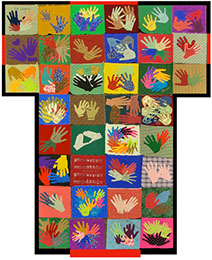
The entire congregation was invited to do a patch — as a family, Sunday School class, or other small group. At the fall harvest happening community event, supplies were passed around and many folks worked on their patched together at that time. In the next two weeks or so, more patches were delivered, and the next step began. A group gathered to lay all the patches out on the floor and create the final design. after we arrived at a grand scheme for the partches, we took a picture of the arrangement, and handed the project off to another group of folks willing to work on the sewing and finishing of the robe. We had enough patches to complete an additional smaller “quilt” which was hung in the Children’s Church room for a period of time.
The artist’s statement that week said: “The community of faith is a beautiful thing when gathered together. Each individual piece adds its own colors and patterns to the larger group of colors. The hands remind us that we all play our part — lending a hand — to the many ministries that make up our own unique dynamic congregation. We’re a collection of diverse personalities, some more bright and lively, some more somber and deep. Imperfections abound. We have committed to “being there” for each other for both the laughter and the tears. Additionally, as we put our community’s focus on Christ, we take on the added responsibility to reflect His love to the world around us.”
6. We Witness to the World
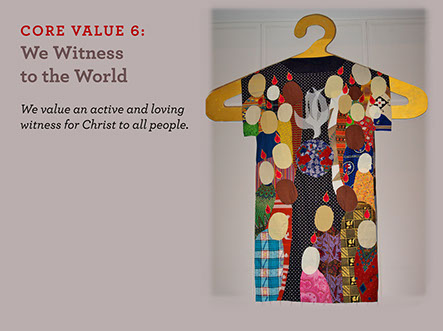
Photo caption: This robe was designed by Geoff Isley, incorporating donated international fabrics, and created by Liz Barr.
With donated fabrics from a congregation like Grantham, we were bound to get fabrics of international origin, because we are blessed to count many retired missionaries as members. The design required traditional ethnic prints from all shimmer at the tops of the heads, and a sheer white fabric hovers over the world in the shape of a descending dove. We hoped this banner would serve as a Pentecost/Missions banner and at other times in the life of the church when the work of the Holy Spirit might be the focus.
The artist’s statement that week said: “The first missions sermon took place with Peter’s sermon to an international congregation — in the streets of Jerusalem — at Pentecost. Each and every person present that day heard the good news in their own language. The Holy Spirit still empowers us to preach Christ to the world. We embrace being one piece of Christ’s global church, while honoring the cultures and languages of other places. We also celebrate our participation in both going into all the world, and supporting the efforts of world missions.”
7. We Serve Compassionately
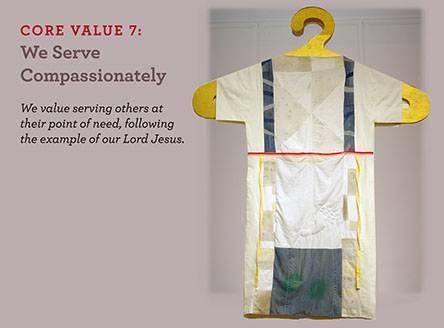
Photo caption: This robe was created Geoff Isley, and lined by Sylvia Emberger. The fabrics are the congregation's donated linen, towels, dishcloths, aprons and work jeans.
Service is a theme we all can connect to in very humble ways. When we asked for fabric donations, we specified we wanted these used, old and worn items: dish towels, aprons, etc. I also was designing this robe intentionally with a much more limited palette of colors compared to the riot of color in some of the previous robes. Like the common nature of much of our day-to-day chores, the quiet beauty of service, this robe doesn’t jump out at you, it receds into the wall, almost invisible. I quilted a large footprint into the lap of the apron to remind us of the Holy Week feet washing tradition among the Brethren in Christ. I colored the denim “knees” of the robe with green dye to simulate the grass stains we all get working in the garden or playing with our children.
The artist’s statement that week said: “The fabric of our lives is filled with serving in small humble ways. We are called to meet others’ needs, following Jesus’ example. We wash dishes, help with the yard work, paint walls, fix things, make meals, and wash each other’s feet. That’s why this robe is made of towels, table linens, jeans and washcloths.
We need that reminder that when we serve others we show them that they are important to us, and to Jesus.”
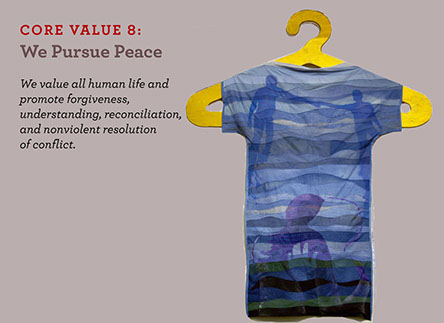
8. We Pursue Peace
Photo caption: This robe was created Geoff Isley. All fabrics were the congregation’s donated jeans.
This was perhaps the hardest robe to design because I wanted to avoid the stereotypical cliches of peace — no doves or olive branches here. To be consistent with the rest of the series I needed to find a visual way to connect peacemaking with one’s everyday life. I found a visual motif while searching for peace-related images on the internet. The image was of reaching across the gap, and another one of embracing.
The artist’s statement that week said: “The subtitle to this chapter by Harriet Bicksler on the eighth core value is ‘we value all human life and promote forgiveness, understanding, reconciliation, and nonviolent resolution of conflict.’ The robe focuses on the human side of peacemaking. We recognize that there are huge gulfs of conflict, ignorance and misunderstanding between us and others, so we must reach across and make contact. When we value others enough to work through our differences, we discover we don't get along with people all the time. We goof up. But it’s worth it to reconcile, to apologize, to embrace and forgive, especially when we are so dissimilar — like the figures embracing on the bottom of this robe.”
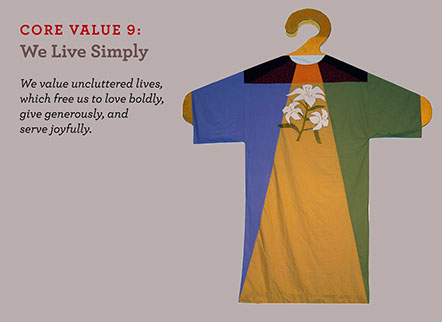
9. We Live Simply
Photo caption: This robe was designed by Susan K. Getty, and created Geoff Isley.
This robe was designed and created very late in the process, because it was coming at the end of the sermon series, and I was just too preoccupied with working on the previous designs and banner construction to really focus on a good idea for this one. I thought simple should be easy— yet it wasn’t at all. I sent out a call for help and one of the replies was from Susan Getty, an artist in the congregation, who simply replied “how can I help?” I asked her to think about finding a visual way to portray”simple” and she promised to work on some sketches for me. When I received her small watercolor and pencil drawing I knew it was perfect, and I then attenpted to recreate it in fabric. I found some bedsheets, sewed them together, and applied the glitter-glue drawing to the top. The robe is more about the three-part subtitle to the chapter, but with the restrained lillies and the simple colors, I think it conveys a truth — that simple can be beautiful.
The artist’s statement that week said: “We strive to live simply so that we can love boldly, give generously, and serve joyfully. This robe stresses that three-part goal of living simply, and acknowledges that living simply isn't always easy. Living below our means is very countercultural, and we need to be reminded to “consider the lilies of the field.” Having money (or time or energy) left over to squander on random acts of kindness is both a joy and a treasure stored up in Heaven.”
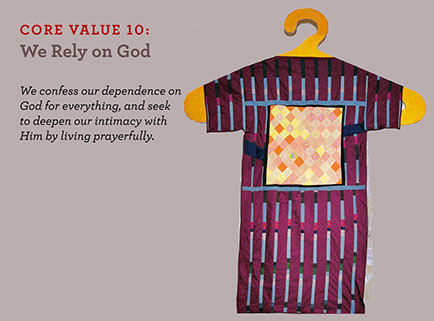
10. We Rely on God by Living Prayerfully
Photo caption: This robe was designed and created by Geoff Isley.
Last, but not least, this robe’s design concept came to me after reading a Lucy Shaw advent poem. I was struck by this image of the omnipotent God of all creation limited and confined to a womb — a short-term prison of sorts —all for our benefit. So, I drew a sketch of a robe with dark prison bars across the whole, pierced by a square window of light. I used donated scraps of fabrics in skin-tones and flesh colors for the window. I wanted the lighter part of the robe to remind us of our direct access to God — prayer — made possible through the incarnated Christ.
The artist’s statement that week said: “Here we are reminded how limited we are, how impossible it would be to attain these core values with our own skill or efforts. It is only by living with a constant sense of God’s presence in our finite, often dark existence that we have assurance that there’s an open window — direct access to Him at any time. We recall that this “Word was made flesh” and was imprisoned in a womb for nine months. He experienced everything that makes us human: even the pain, suffering, doubt, and temptation. We can be confident that He knows our need, and His light shines through that window of prayer to guide us, comfort us and empower us to see beyond our limitations, so we can live in total reliance on God.”
About the Author
Geoffrey Isley is a member of the Grantham Church, and lives in Grantham with his wife Dawn and three grown sons. A 1987 graduate of Messiah College with a degree in fine art, he has worked as a graphic artist for 26 years.
ALL RIGHTS RESERVED 2026